

Discover New York City Trees
Featured Book and Photographs
Explore Gail’s latest book celebrating the wonderfully expressive trees she has recently met in New York’s City Hall Park. Photos featured in the One Art Space Gallery at 23 Warren Street, April 22-27, 2025.


Author Gail Karlsson set out to learn about the trees in New York’s City Hall Park in lower Manhattan, and found some fascinating new friends and neighbors.
After almost 40 years living across the street, she decided to get to know the trees in connection with a project for the Friends of City Hall Park. It turned out to be quite challenging, as there was no easy source of accurate information for some of the ornamental trees planted in the park.
She encourages us to get acquainted with the trees in our own neighborhoods, and to appreciate the many ways they support us and grace our lives.
“Often I stood in front of a tree for a long time circling around searching for clues in its branches, or on the ground. Sometimes I spoke to the trees, asking for information or admiring their beauty. I touched their bark and caressed their leaves. It seemed like I could feel their energy. Some of them became special friends and I was eager to sit and visit with them when I went out to the park.”
“Trees from around the world have been planted in the park, and their lives are in many ways controlled by people. Yet even though they may have little in common, they still form a community, connected with each other – and with us too, as neighbors.”
“When I was getting familiar with the different trees, one particular elm seemed to have a sassy face on it. Then I began to see expressive looks on many of the other trees. Wow, I thought, they’re looking back at me. How do they feel about me, I wondered. About us. About their lives in New York City.”
“Some of them must have seen successions of Mayors, City Council members and government officials, plus thousands of public events – demonstrations and protests, celebrations and parades. Witness trees.”
“It’s common now to reference the ways trees communicate with each other, through underground networks of fungi or airborne chemical signals. Walking among the trees is touted as good for our immune systems. All those airborne chemicals and the cooling, calming shade. However, more important, I think is that trees are able to use the magic of photosynthesis to create energy and matter from light, supporting life on earth, including ours, and producing oxygen for us to breathe.”
“I invite you to introduce yourself to a tree, any tree, and get to know it better. Maybe say thanks.”
The trees in City Hall Park include beech, buckeye, catalpa, cedar, cherry, crabapple, crape myrtle, dawn redwood, dogwood, elm, gingko, hawthorn, holly, horse chestnut, linden, London plane, magnolia, maple, oak, pine, plum redbud, snowbell, spruce, sweetgum, tupelo, viburnum, and more.
2025 – Order on Amazon.com


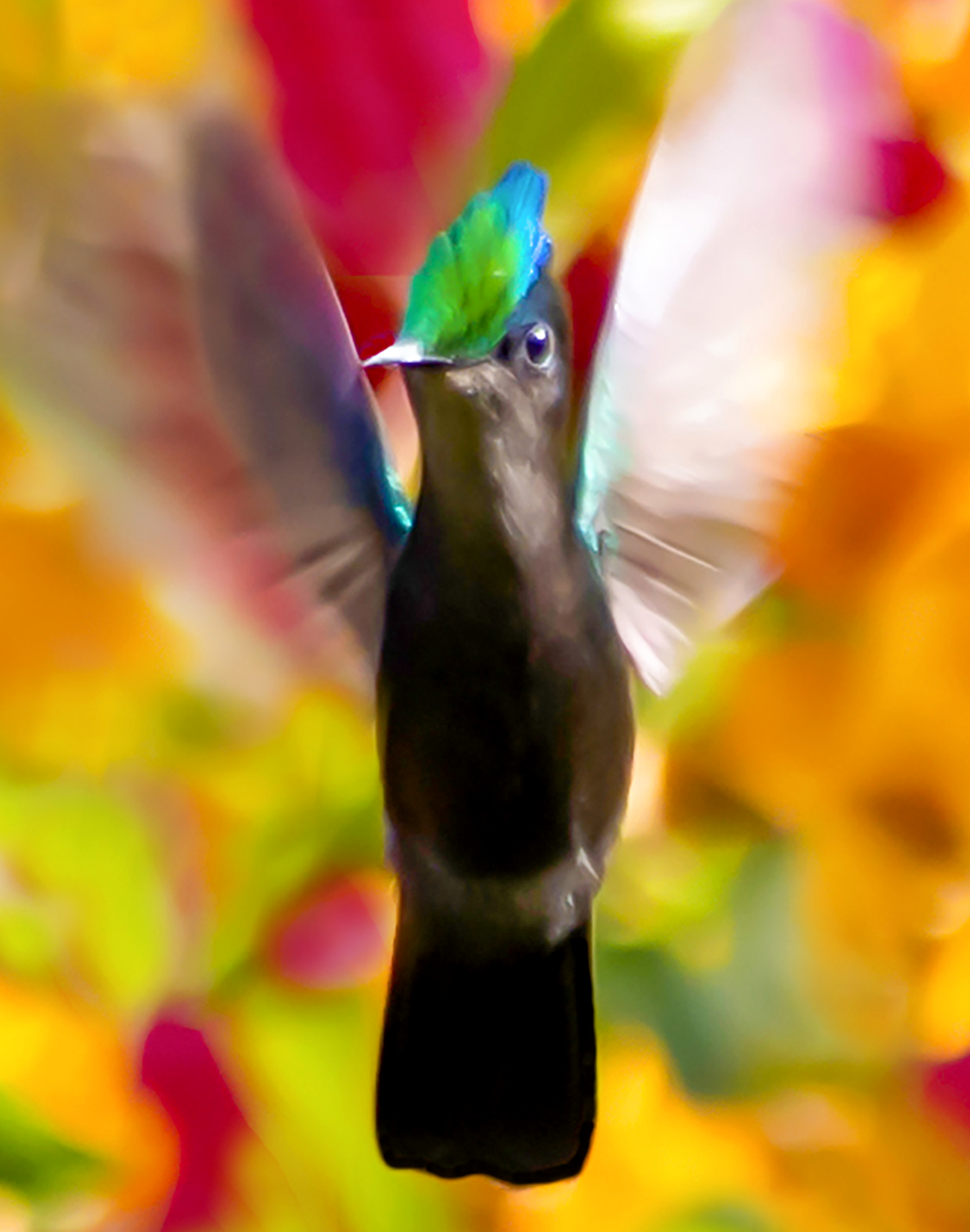


From the May 2025 St. John Source review;
‘Looking for Birds on St. John’ is the result of years of patient observation and meticulous photography by Karlsson, and so far, it’s received rave reviews. “It’s the best bird guide for St. John anywhere,” said Audubon Society board member Angela Ebner. “It’s informative without being overwhelming. And it has interesting little facts that help you remember the bird later.” Karlsson says she wanted to write a book that was informative yet conversational, and light enough for people to carry around and take notes in.
“I think this book fills a huge void,” said Phyllis Benton, cofounder of St. John Wildlife Rehabilitation. “When I moved down to St. John, I found many beautiful comprehensive books on Caribbean birds, but I could not find anything about this part of the island chain. Our birds are not the same as on Grand Cayman or Trinidad.”
Karlsson’s book seeks to identify common birds seen around the house, along the road or by the shore, as well as birds that fly down to St. John for the winter; she also includes common migratory birds on their way somewhere else and some “local celebrities,” like flamingos and ibises.
“Once you learn to recognize local birds and the sounds they make, you can feel like you have new friends and neighbors,” she writes in the book’s introduction. “You might hear them calling and look up to say: ‘Those are White-winged Doves on the wire.’”
Karlsson had a career as an attorney fighting for environmental causes and human rights when she began writing books about nature on St. John, including “The Wild Life in an Island House” and a guide book “Learning About Trees and Plants” — A Project of the Unitarian Universalist Fellowship of St. John.
Karlsson’s book is on sale at Bajo El Sol Gallery & Art Bar and other locations in the Virgin Islands as well as on Amazon.

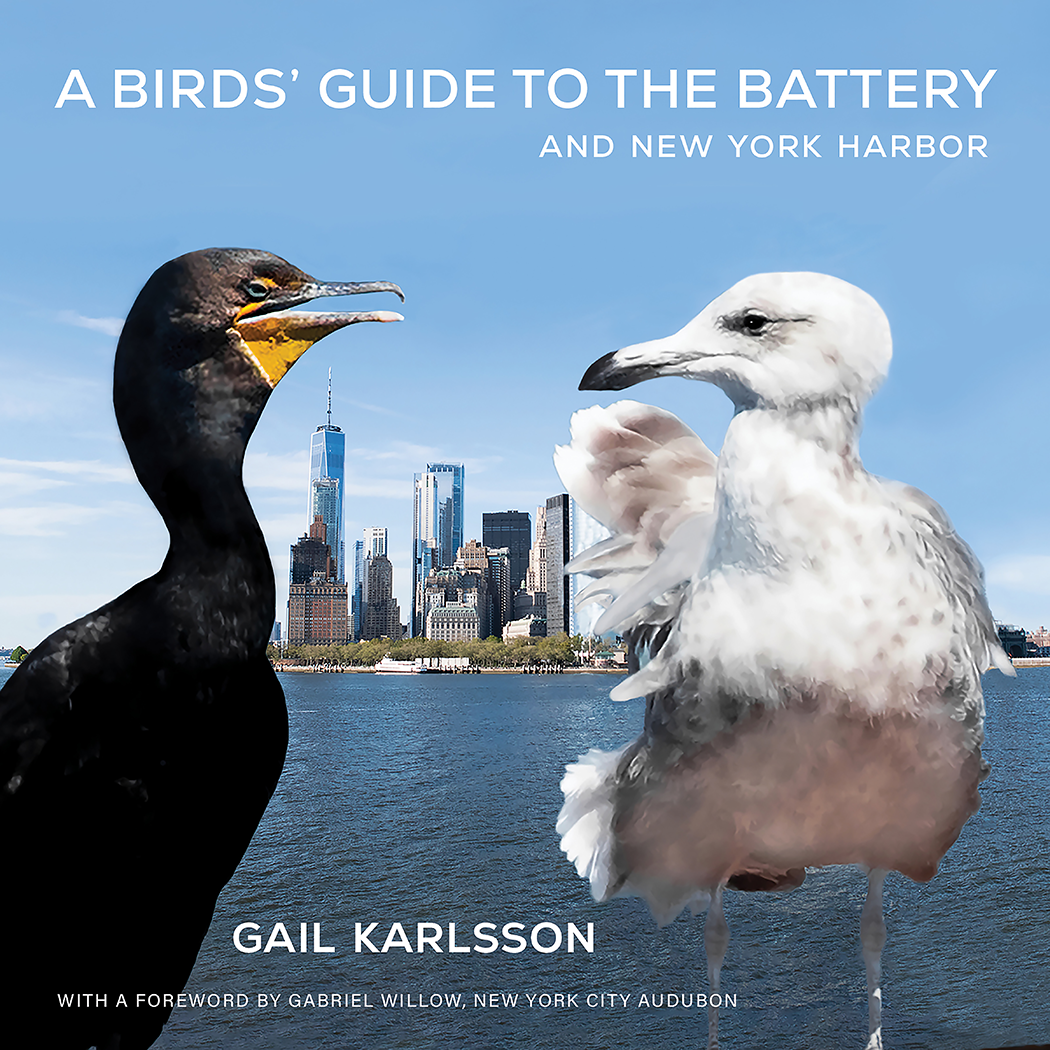


2022 – Available on Amazon.com
From the Foreword by Gabriel Willow, NYC Bird Alliance (formerly NYC Audubon Society): This book is the result of Gail’s careful and close observation of the many birds of The Battery, her artful photographs combined with wry and witty notes. To date, over 175 species of birds have been found in the park, a remarkable total. Some have been lucky enough to have their portraits taken by Gail, and are immortalized in this book. Hopefully these portraits will inspire you to see what overlooked avian wonders await in your local park as well.
From the Tribeca Citizen: Longtime Tribecan Gail Karlsson, whose photographs of local birds are in the Western Union windows on West Broadway and Thomas, has also just released a new book titled “A Birds’ Guide to The Battery and New York Harbor.” She first started shooting downtown birds in 2017 after a bird walk in The Battery with Gabriel Willow, a naturalist from New York City Audubon. “One day he told me that not very many birders went to The Battery, and it would be good to document what we saw there. I didn’t know much about the different birds, but I did have a new telephoto lens, and Gabriel helped me identify ones I didn’t recognize. I was amazed at how many different types of birds we found there, including Red-tailed Hawks. “They are so wild and powerful,” she says, “and surprising in such an urban space.” Her interest in nature photography is a satisfying creative reflection of her career as an environmental lawyer and activist, working first at the EPA in DC then with a law firm at 26 Broadway and after that as a consultant on energy and climate policy for the UN Development Program and other international organizations. In the 1990s and early 2000s she was also the New York representative for the Citizens Network for Sustainable Development, a nonprofit group active with the UN Commission on Sustainable Development, as well as local NYC issues..”
From The Tribeca Trib https://tribecatrib.com/content/birder-mission-documenting-batterys-avian-riches
Birder on a Mission: Documenting The Battery’s Avian Riches

Left: Gail Karlsson in Battery Park. Right: Karlsson’s photo of a Blue Jay, which appears in her book, “A Bird’s Guide to the Battery and New York Harbor.” Photos: April Koral/Tribeca Trib
About 10 years ago, a college friend talked Karlsson into going birding with her. She liked it and volunteered to be a “citizen scientist” for NYC Audubon, helping collect data about birds foraging in Jamaica Bay. Then in 2017 she read about bird walks in The Battery, which is on a spring and fall migratory route. Since the Battery Conservancy overhauled the park, filling it with native plants, it has become a popular way station for migrating birds. The walks were once a week, but Karlsson started going to the park every day. “I had no idea that there were so many birds here. I would show my bird pictures to friends who would say, “Wow, they’re in New York City? That can’t be.” Soon after she discovered The Battery as a sanctuary for birds, Karlsson’s husband became gravely ill (he is now okay), and she stepped back from her environmental work for the United Nations. The park became a sort of salvation for her. “I had a lot of things to worry about but I could look forward to coming down here and seeing the birds. Sometimes I would sit in the labyrinth area [in the northwest corner of the park and listen to the birds and be in a kind of zen-like mode.” She recalled feeling “comforted” by them; they became her “companions.” “Not that they gave me advice or said how much they liked me,” she said with a laugh, “but they called my attention to their lives, and that gave me a broader perspective on my own.” “You know,” she added, “birds always had a spiritual role in ancient times. They were messengers connecting us to the gods. I didn’t experience them that way, but I do see them as showing me their way of being in the world. And maybe that’s spiritual, too.”

Left: Yellow-bellied Sapsucker. Right: Yellow Warbler. Photos: Gail Karlsson

Top: European Starlings. Above: Ovenbird. Photos: Gail Karlsson

Available online and at the Virgin Islands National Park bookstore in Cruz Bay, St. John
Review in the St. John Source November 2016 by Amy Roberts
Get to Know Your Local Trees with a New Guidebook

Gail Karlsson saw a need for an easy-to-use guide for identifying the flora of the islands and, working in collaboration with the Unitarian Universalist Fellowship of St. John, has developed a handy new book, “Learning About Trees and Plants.” Karlsson’s book is designed to make it easy for residents and visitors to identify common local trees and shrubs by two simple methods. The first is by leading readers on a walking tour of the trees of Cruz Bay. Using the photos, maps, and pithy text, readers can use the book to identify individual trees as they wend their way around Cruz Bay, pausing to notice the leaves, bark, flowers, and fruits, among other characteristics. But if strolling around Cruz Bay is not an option at the moment, the second half of Karlsson’s book offers another method for tree and shrub identification. It is organized by distinguishing characteristics, such as flowers, seeds, or the presence of thorns.
Using the photos, maps, and pithy text, readers can use the book to identify individual trees as they wend their way around Cruz Bay, pausing to notice the leaves, bark, flowers, and fruits, among other characteristics, so that they can recognize the next Genip, Gri-gri, or Poui they encounter. Karlsson worked with botany experts Kevel Lindsay and Eleanor Gibney to provide the scientific names as well as the most common local names. Kevel Lindsay steered her to applying for a grant from the Urban and Community Forestry Division of the US Department of Agriculture and Karlsson, along with Suki Buchalter, enlisted the Unitarian Universalist Fellowship on St. John to take it on as a community service project. The group had already encouraged people to learn about and appreciate trees by organizing tree walks and sponsoring Earth Day activities. “Learning about trees served as a lens through which to consider the meaning of the Unitarian Universalist principle of respect for the interconnected web of existence – deepening our recognition of the degree to which people’s lives have been shaped by the dependence on trees and plants, as well as the impacts we have on the landscapes we inhabit,” she wrote in the book.
The book’s walking tour section was revised in 2019, after two category 5 hurricanes caused serious damage to the Virgin Islands, and an assessment was added about the impacts of the storms on the landscape and wildlife in the islands.

Available on Amazon and online, and at stores on St. John
@Work: Writing About Wildlife on St. John – VI Source staff July 13, 2005
Gail Karlsson has come out with a must-read for anybody who lives in the tropics. “The Wild Life in an Island House” tells all about the creatures you’re likely to encounter. While you might expect to meet up with mosquitoes and a spider or two, were you expecting scorpions and bats? They’re all here, and more. Virgin Islands residents will relate to many of her stories. A family trip to St. John convinced her husband that he could do his computer programming job long distance, and they have moved back and forth between St. John and New York for several years.
“One of our wildest times was the night the termites flew up,” she wrote. She goes on to talk about the strong thunderstorm that preceded the termites’ flying, the power going off and on, and then the thousands of termites drifting down on her family. “It felt like the night of the living dead,” she wrote. Karlsson goes on to explain the science of why this happens. She said that the termites fly as part of a planned dispersal so new nests can be formed. Some pair off, drop their flimsy wings and begin mating. She said it usually happens after the first heavy rain in the fall.
Karlsson got the idea to write the book after she had written similar environmental pieces for the “St. John Times.” She said she normally writes more weighty pieces in her role as a consultant the United Nations Development Programme. “I’m teaching an online course for the staff in environmental policy,” she said. She sees that her United Nations work on sustainable development has a link to “The Wild Life in an Island House.” She wrote that she particularly likes the way ants, birds and fruit rats help her dispose of organic garbage so they don’t have to be shipped to the landfill on St. Thomas. “I really think we have some environmental and political interests in common,” she wrote.